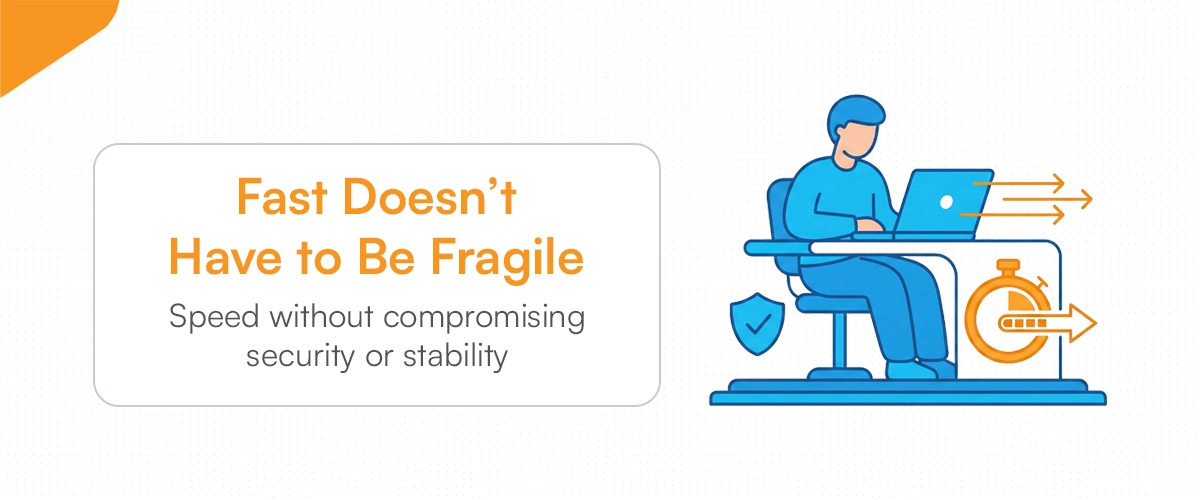
In today’s fast-moving tech world, speed is no longer a luxury — it’s an expectation. Product teams want new features rolled out almost as soon as they’re imagined. Business teams are under pressure to reach the market faster than competitors.
Customers expect constant improvements, smoother experiences, and absolutely zero downtime.
In the middle of all this sits the DevOps team — balancing ambition with reality.
Because while everyone wants faster releases, DevOps teams often carry a quiet, constant fear:
“If we deploy faster, are we also deploying risk?”
A single rushed deployment can mean broken production, security vulnerabilities, late-night rollbacks, and emergency calls no one wants to attend. Speed sounds great — until stability is compromised.
The good news is this:
Speed and safety are not opposites.
With the right mindset, tools, and practices, it is absolutely possible to reduce deployment time while keeping systems secure, stable, and predictable. In fact, when done correctly, security and stability often enable speed rather than slow it down.
Let’s break this down in a practical, real-world way.
The Real Problem With “Fast Deployments”
Slow deployments are rarely caused by technology. More often, they’re the result of inefficient processes. Too many manual steps, fear of breaking production, late security checks, inconsistent environments, and painful rollbacks all add hesitation to the release cycle.
To move faster, teams often cut corners:
- Skipping tests
- Bypassing security checks
- Deploying directly to production
This may feel fast at first, but it’s fragile. When something breaks, the cost quickly outweighs the time saved — leading to emergency fixes, rollbacks, customer impact, and lost trust.
True deployment speed doesn’t come from shortcuts.
It comes from confidence — confidence that the code is tested, security risks are addressed early, environments are predictable, and failures can be detected and rolled back quickly.
When teams trust their deployment process, speed becomes natural — not forced.
1. Automate Everything (But Don’t Automate Blindly)
Manual steps are slow by nature.
They depend on people, timing, and perfect attention — which is rare during busy releases.
Manual steps are also the easiest place for mistakes to slip in, especially under pressure.
Automation removes uncertainty and repetition from the deployment process. When machines handle routine tasks, deployments become faster, consistent, and far more reliable.
What to automate
- Build process – Docker image creation, artifact generation, and dependency installation
- Tests – unit tests, integration tests, and linting to catch issues early
- Security scans – vulnerability checks and policy validations
- Deployment steps – fully automated and Streamlined CI/CD Pipelines from build to release
Automation ensures that every deployment follows the same path, every single time.
What not to skip
Automation should enforce rules, not help teams avoid them.
Good automation:
- The pipeline automatically fails when tests fail
- Deployment is blocked if security vulnerabilities are detected
Bad automation:
- “Force deploy” buttons that bypass safeguards
- Skipping checks just to save a few minutes
In platforms like CloudLaunchPad, automation is treated as a first-class citizen. Build, test, security checks, and deployments are triggered through standardized pipelines, ensuring that every service follows the same rules. This removes human dependency while still enforcing guardrails — no manual shortcuts, no surprise deployments.
2. Use Container Images Properly
Containers are not just a way to run applications — they are a way to achieve predictable and repeatable deployments. When used correctly, containers remove environment-related surprises and significantly reduce deployment time.
Best practices that save time
- Build once, deploy everywhere – the same image moves through dev, staging, and production
- Use multi-stage Docker builds – smaller images, faster builds, fewer attack surfaces
- Cache dependencies – reuse pip, npm, or composer layers instead of reinstalling everything
These practices ensure that what you test is exactly what you deploy.
This avoids
- Rebuilding applications separately for every environment
- The classic “It works on staging but not on prod” drama
When your container image is already built, tested, and approved, deployment becomes a simple runtime action:
Pull image → run container → done
Fast, predictable, and safe.
3. Shift Security Left (Earlier = Faster)
Security often feels like it slows deployments — not because it’s unnecessary, but because it arrives too late in the process.
Instead of : Build → Deploy → Oh no, security issue
Do this instead
- Dependency scanning during build to catch vulnerable libraries
- Image scanning before pushing to the registry
- Secrets detection during CI to prevent accidental leaks
When security runs early, it:
- Finds issues when fixes are simple and inexpensive
- Prevents last-minute deployment blocks and delays
4. Keep Environments Consistent
Different environments lead to surprise bugs — and surprise bugs always slow deployments.
When development, staging, and production behave differently, every release feels risky.
To avoid this, make sure:
- Dev, staging, and production use the same base images to eliminate environment drift
- Configuration changes are handled via environment variables, not hardcoded values
- Infrastructure is managed as code using tools like Terraform or CloudFormation
Consistency reduces uncertainty and builds confidence in every release.
5. Deploy Small, Not Big
Big deployments slow everything down because:
- More things can break at once
- Rollbacks become complex and stressful
- Testing takes longer, and approvals pile up
Instead of waiting and releasing everything together:
- Deploy smaller changes more frequently
- Use feature flags to control visibility
- Release features behind toggles
Small changes lead to:
- Faster testing cycles
- Faster approvals
- Faster and safer rollbacks
It’s like moving houses – One suitcase at a time is far easier than trying to move everything in one truck.
6. Smart Health Checks and Rollbacks
Fast deployments don’t mean reckless deployments. They mean being prepared for failure and handling it quickly.
Always have:
- Application health checks to confirm the app is actually working
- Readiness and liveness probes to control traffic safely
- Automatic rollbacks when something goes wrong
This setup allows you to:
- Deploy with confidence
- Detect failures early, before users notice
- Recover instantly without manual intervention
Nothing slows teams down like manual firefighting.
Good rollback strategies save hours — and sometimes even days.
CloudLaunchpad integrates service-level health checks and deployment status tracking, allowing teams to quickly identify unhealthy services and take action. This minimizes downtime and removes the need for manual recovery during failed deployments.
7. Monitor What Actually Matters
Don’t wait for users to tell you something is broken. By the time they notice, the impact is already real.
Focus on tracking:
- Error rates to catch functional issues
- CPU and memory usage to spot resource pressure
- Pod or task health to detect instability
- Deployment success and failure metrics to measure reliability
When monitoring is solid:
- Problems are identified early
- Teams trust the Modern Deployment Pipeline
- Releases move faster with less fear
Speed increases when fear decreases.
This is where platforms like CloudLaunchPad add significant value. Cloud Launchpad provides a unified monitoring view across all deployed microservices, showing service health, pod or task status, and CPU and memory usage in one place. Instead of jumping between tools, teams can quickly understand what’s happening, correlate issues with deployments, and respond before users are impacted.
When teams have clear visibility, they trust the system more — and when trust increases, deployment speed naturally follows.
Final Thoughts
Fast deployments are not the result of shortcuts — they are the result of strong systems and trusted processes. When automation, security, consistency, and monitoring work together, teams can release changes quickly without increasing risk. Sustainable speed comes from confidence, not urgency.
Footer